Yu-Chia Pai · New Media MFA

The Clash

Exploring Memory Through the Materiality of Digital and Traditional Art

The Clash is a practice-based new media installation that re-engages personal and cultural memory through painting, projection mapping, real-time interaction, and generative AI. Beginning from acrylic paintings of remembered places in Taiwan, the project transforms memory into an immersive digital environment where viewers use their gestures to reveal, distort, and rediscover layered images.

The Clash investigates how personal and cultural memory can be re-engaged through the material tension between traditional painting, generative AI, and real-time interactive projection. By transforming acrylic paintings into AI-generated hallucinations and gesture-controlled immersive environments, the project asks how artists can remain in control of digital systems while using technology to expand, rather than replace, human memory and creative intention.

Memory as Process, Not Archive

Memory is not treated as a fixed archive, but as a tension between the transient and the permanent. Personal remembering is fleeting, embodied, and unstable — shaped by place, distance, and emotion. Cultural memory leaves traces that feel enduring, yet shift each time they are translated across media. This project begins from my experience between Taiwan and Canada, asking how memory changes when it moves between touch, image, interaction, and projection.

Transient / Permanent — fleeting memory vs enduring cultural trace

Personal Memory

Personal memory lives in the transient — it fades, shifts, and is reimagined each time it is recalled.

  • Memory is connected to place, family, architecture, street scenes, and everyday images in Taiwan.
  • Remembering is tactile and visual — through brushwork, texture, and fleeting digital captures.
  • Personal memory is unstable and reinterpreted, not stored perfectly.

Cultural Dislocation

Memory, place, and time collide — personal reinterpretation becomes an ongoing experience, not a single remembered moment.

  • Studying in Canada intensified the clash between familiar Taiwanese memory and foreign present experience.
  • Locations once felt permanent become distant, fragmented, and emotionally reconstructed across time.
  • The gap between here and there makes remembering feel like an active, unfinished process.
  • Four media approaches below present this collision through different essences — digital, particle, tangible, and machine-led discovery.

Artistic Response — Approaches & Media

The project does not choose transient or permanent — it negotiates between them through a layered media system.

  • Acrylic painting — tactile, permanent-seeming foundation; carries touch and subjective origin.
  • 3D modeling — reconstructs remembered space; bridges physical memory and virtual form.
  • Projection mapping — introduces time, movement, and instability as a transient layer.
  • Generative AI — expands memory into hallucinated, uncertain variations.
  • Gesture interaction — memory becomes responsive, embodied, and never fixed.
  • Can the tactile and symbolic richness of traditional media be preserved and remain valid when reinterpreted in a digital context?
  • Does digitizing memory and cultural experience enhance or reduce its emotional depth?
  • Does interactivity belong only to digital media?
  • Is there another form of interactivity that also exists in traditional or physical media?

Memory, Cultural Dislocation, and Ongoing Experience

This project is shaped by the personal reinterpretation of a clash between memories, locations, and time. Living between Taiwan and Canada, I do not treat memory as something settled. It is an ongoing experience — a collision between what was familiar, what feels foreign, and what keeps shifting as it is translated across media. Four approaches present that collision in different ways and essences.

The Clash — The Particle Memories

The work is a triptych exploring the fragmented nature of memory, inviting the viewer to delve into personal memories through the idea of dynamic memories being interpreted over time — becoming blurry or clear again depending on how people engage with it.

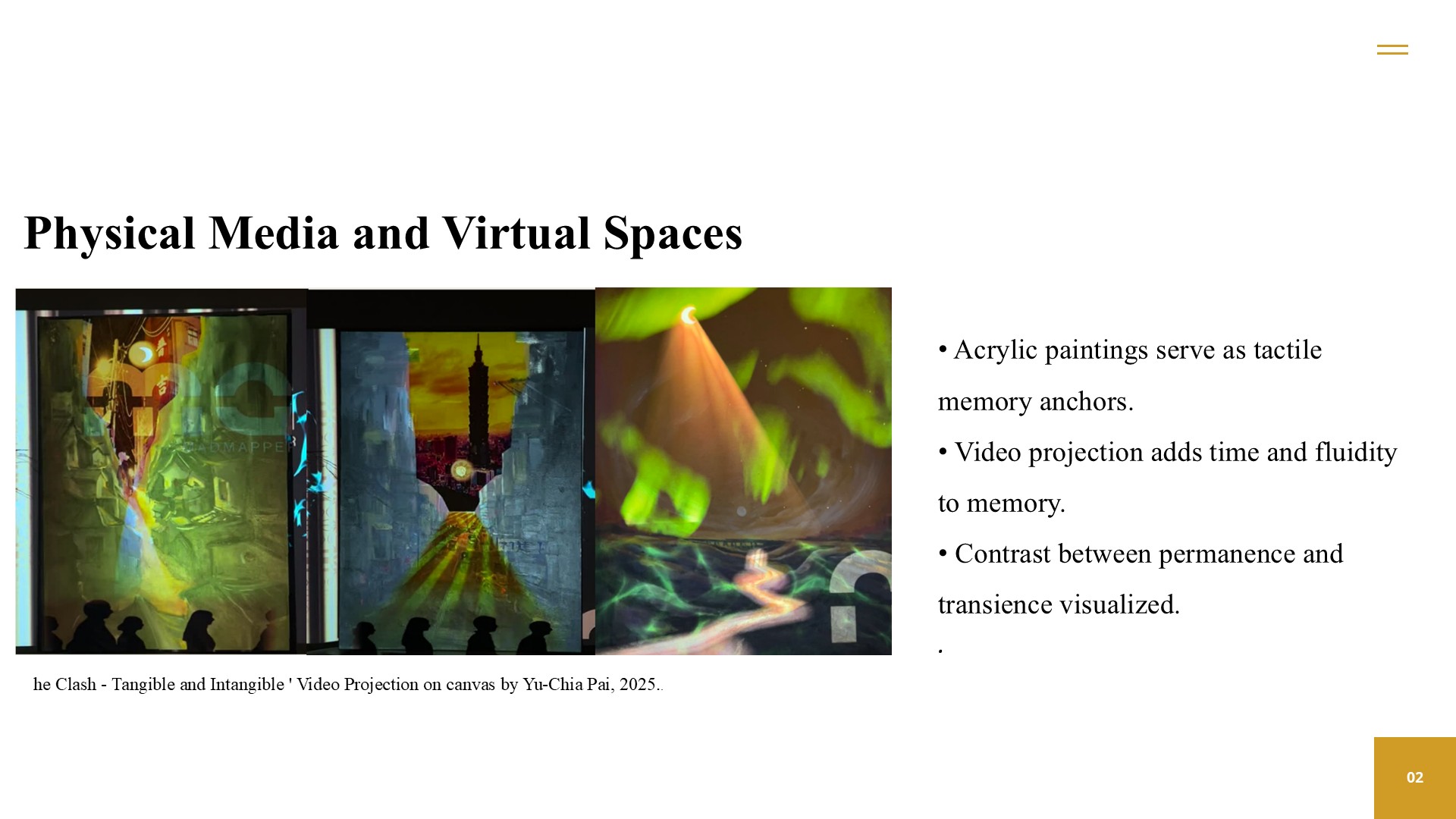
The Clash — Tangible and Intangible

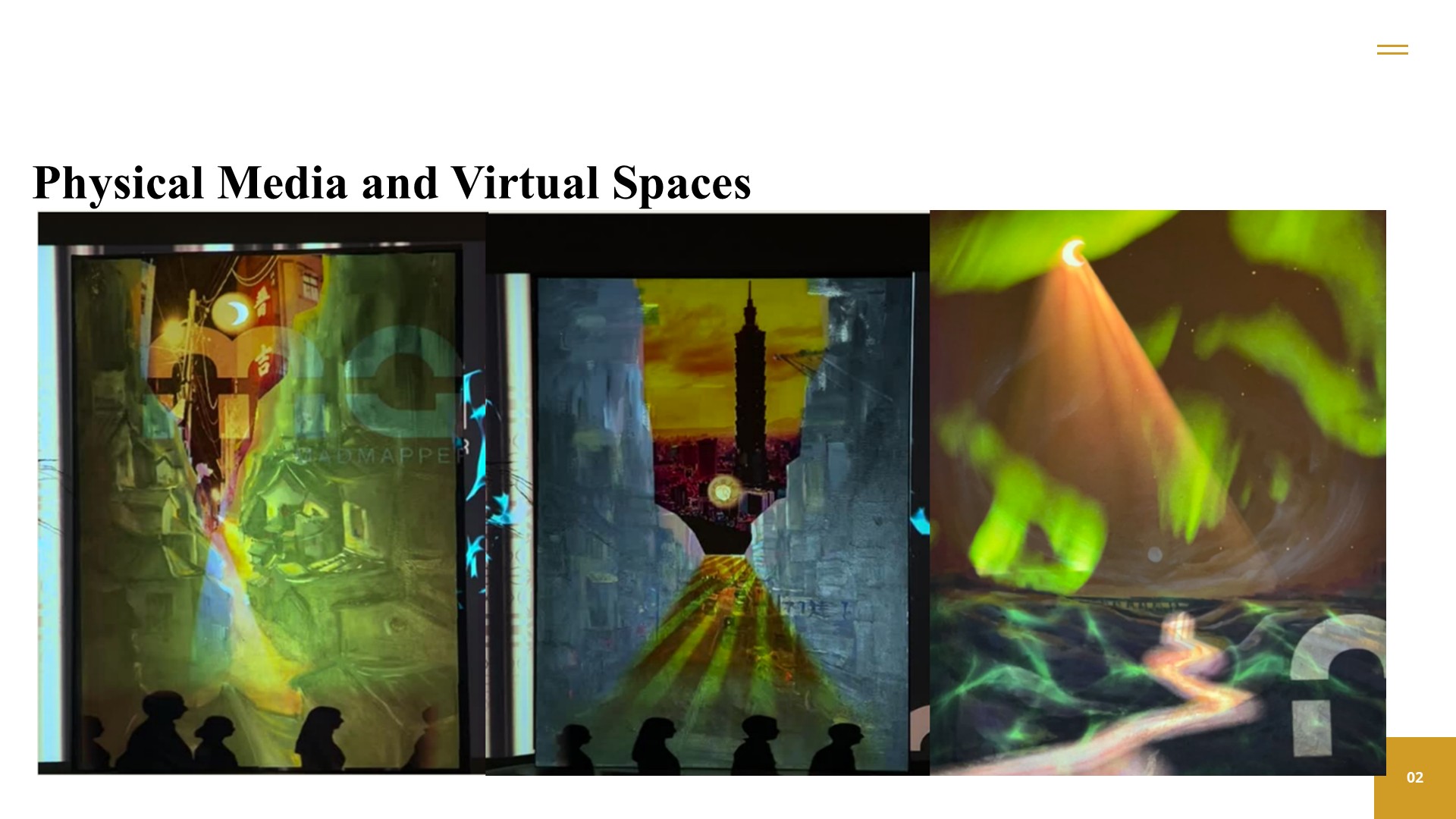
A triptych exploring the tactile qualities of traditional media as a method of documenting personal memory, using acrylic paintings as the foundation. Paintings from left to right — Changhua City, Chiayi City, and Lethbridge City — capture imagery from different stages of my life, with videos of each place projected onto the canvas.

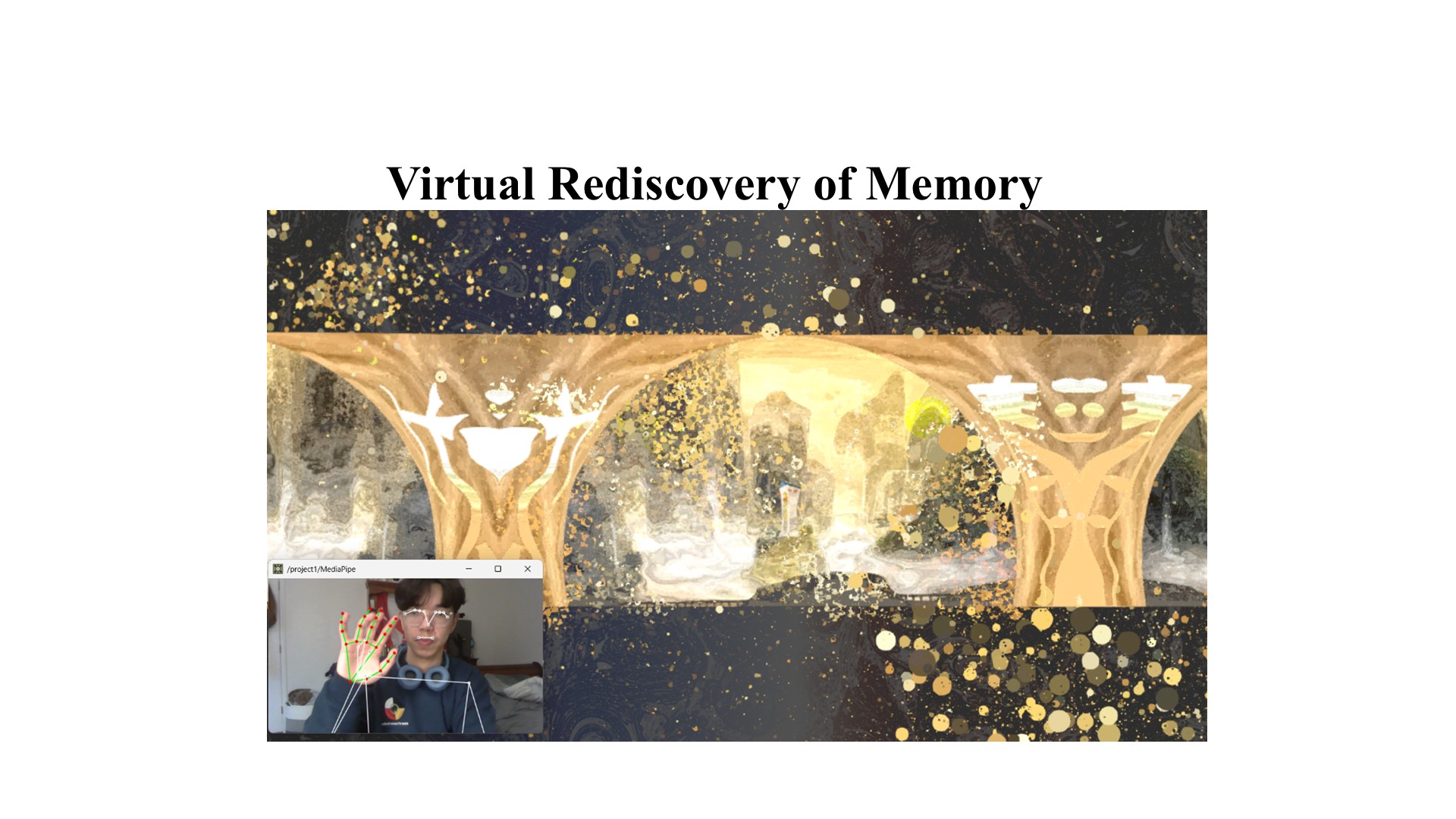
The Clash — Memory Exploration in Digital World

The work encapsulates the insecurity and unease of an artist who practiced mainly in traditional media, then gradually transitioned to digital and mixed media — exploring how remembered places expand into virtual, dream-like environments.

The Clash — Memory Discovery

Interactive works that treat remembering as active discovery. Through gesture, the viewer re-engages countryside memory, symbolic dream space, and everyday family sites — memory becomes something to uncover rather than passively recall.

Case Study: FamilyMart Memory Space

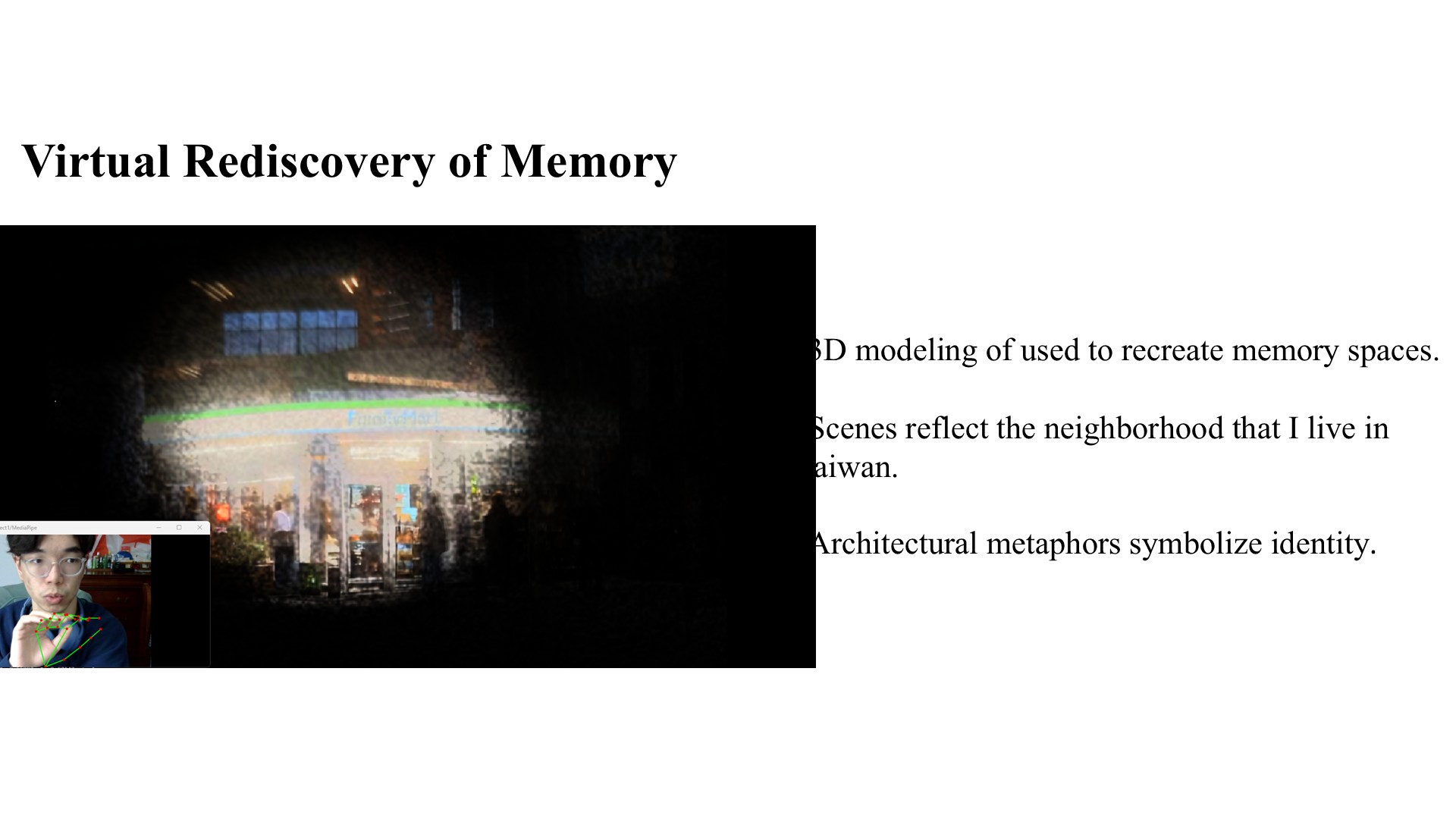
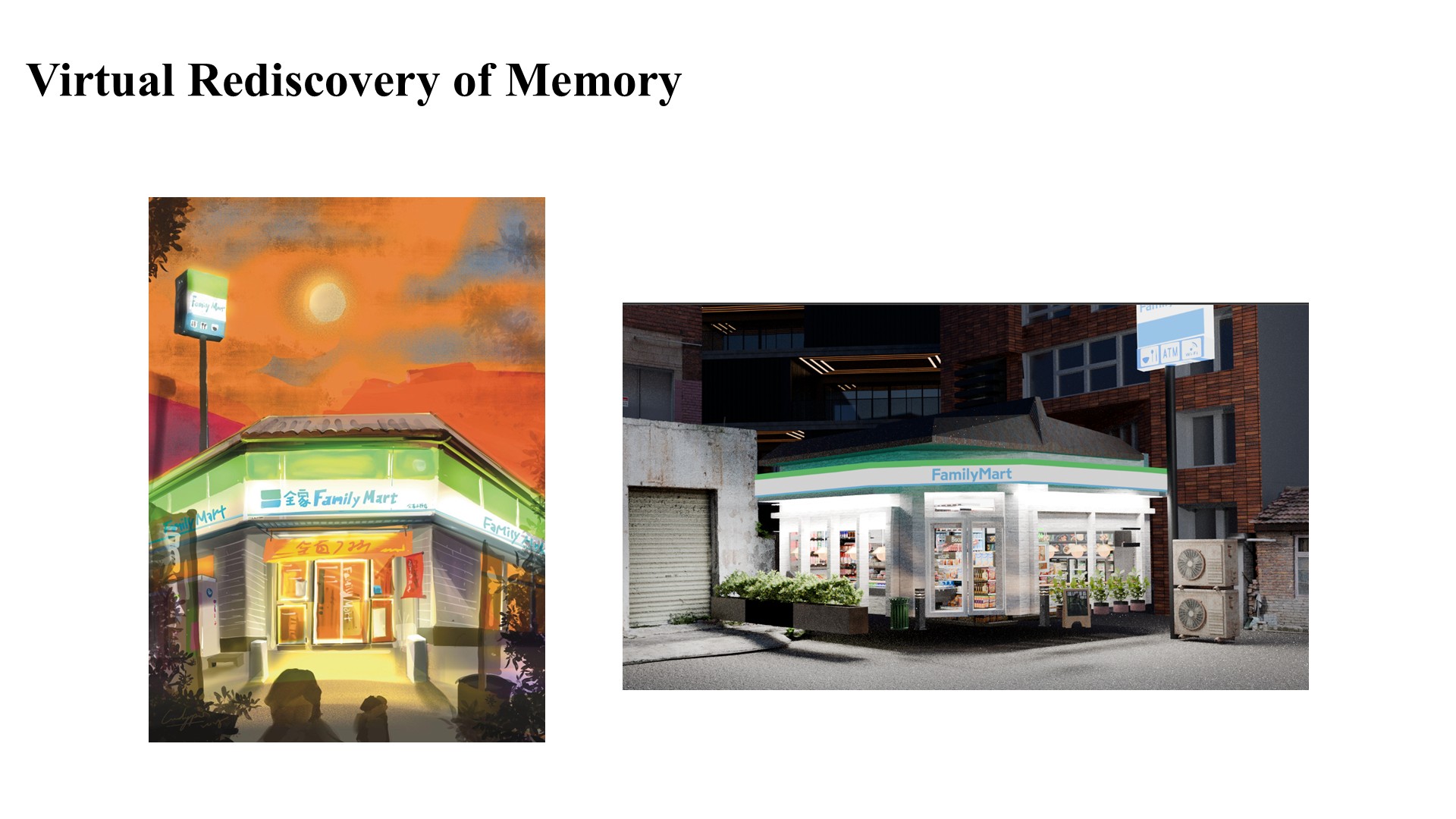
The FamilyMart scene condenses this clash into one symbolic site — everyday Taiwanese architecture, childhood familiarity, and cultural identity encountered across distance. The painted image holds a personal, transient trace; the digital reconstruction offers a reinterpreted form of permanence. Both shift each time they are encountered.

FamilyMart painted memory beside 3D digital reconstruction

Painted memory based on a familiar Taiwanese street corner.

Digitally reconstructed memory space used for projection and interaction.

Floral Window (花窗) — Cultural Symbol

  • Patterns on floral windows and tiles were hand-designed to record what people encountered in life.
  • Repetitive motifs carry symbolic meaning — flowers suggest prosperity; vase suggests peace and joy.
  • Pattern and symbol act as cultural encapsulation, documenting history, context, and incident.

These videos trace how a culturally loaded architectural motif moves from experiment to applied memory space — the floral window becomes both symbol and interactive surface within the larger clash of location, time, and personal reinterpretation.

Experiment — early test using the floral window concept in projection
Application — proper integration within the FamilyMart memory space

Materiality, Remediation, and Recollection

The project is informed by Walter Benjamin's discussion of aura, Lev Manovich's theory of new media, Nam June Paik's relationship between technology and presence, and Rinehart and Ippolito's discussion of media preservation and social memory.

Traditional Media

Acrylic painting carries touch, texture, brushwork, and subjective memory. It becomes the foundation layer of the project.

Digital Media

Projection, animation, and interaction allow memory to become unstable, moving, and responsive.

AI Hallucination

Generative AI is used not as an author replacing the artist, but as a tool for expanding remembered images into dream-like variations.

Viewer Interaction

The audience's gesture becomes part of the remembering process. Memory is revealed, erased, distorted, and reconstructed through movement.

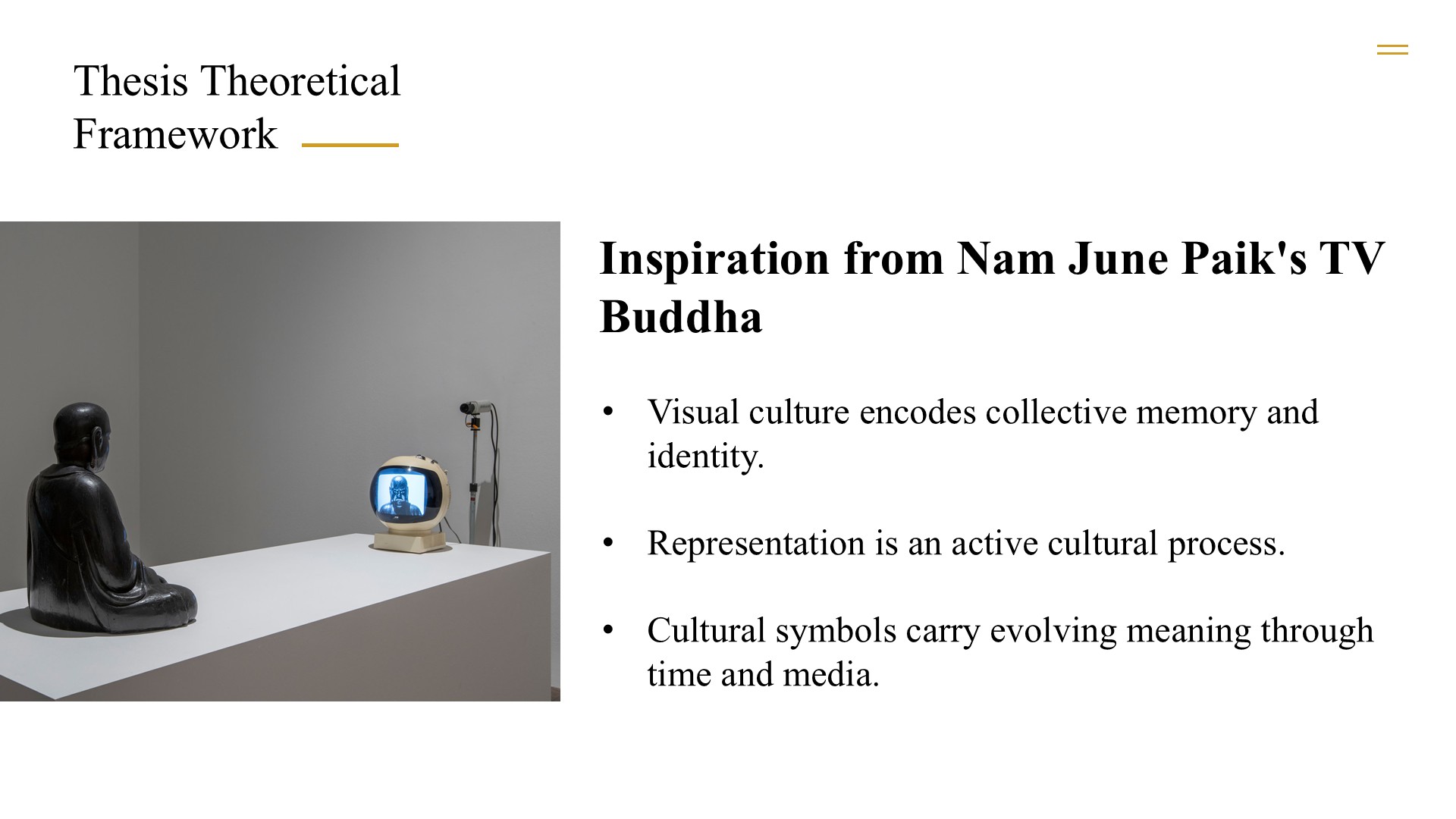
Nam June Paik TV Buddha installation reference
Inspiration from Nam June Paik — technology and meditative presence in loop.
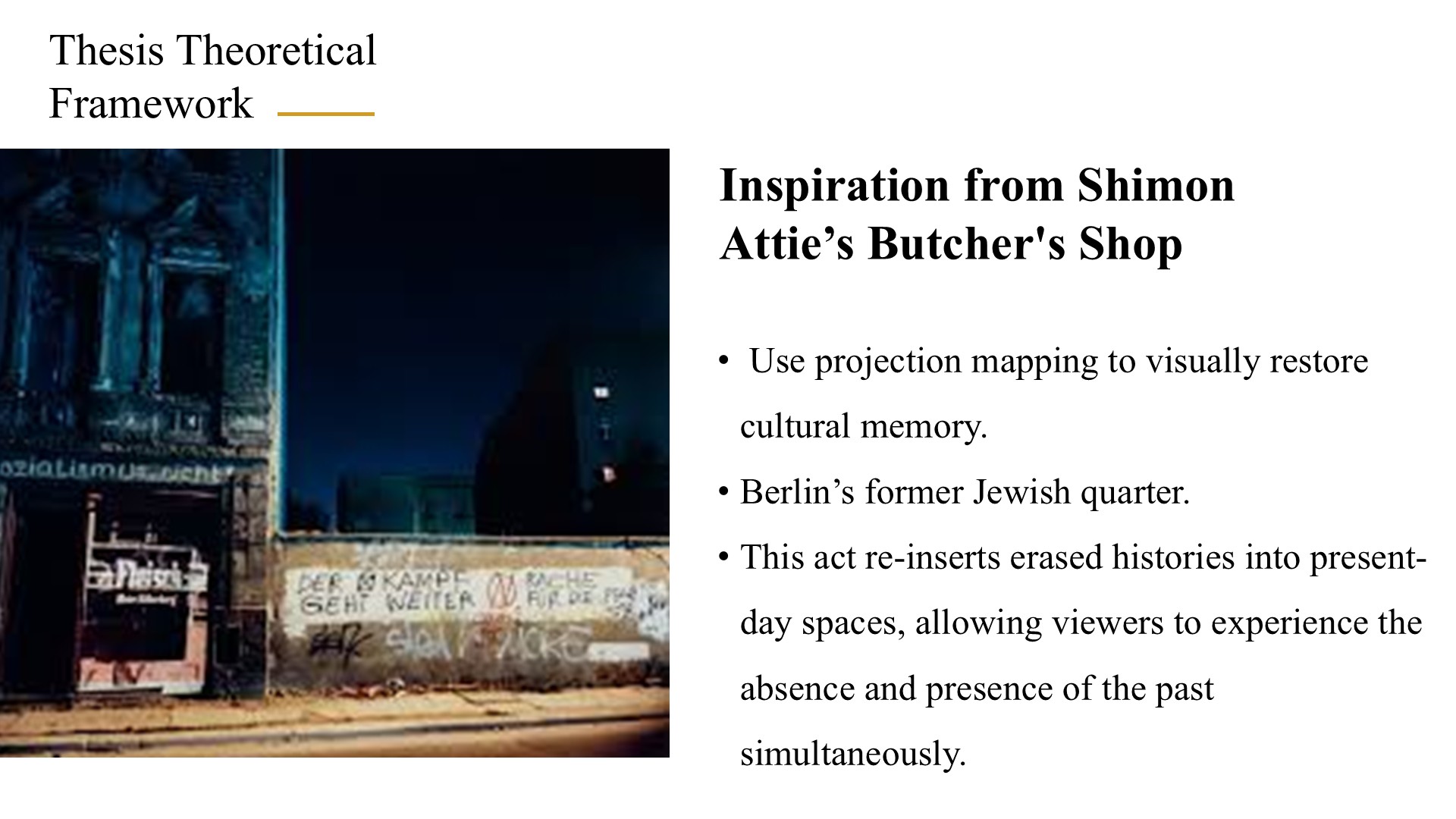
Shimon Attie projection mapping on Berlin building
Inspiration from Shimon Attie — projection mapping to restore cultural memory.

Theoretical Influences

  • Walter Benjamin — aura and mechanical reproduction
  • Lev Manovich — new media, modularity, and variability
  • Nam June Paik — technology and presence
  • Rinehart & Ippolito — media preservation and social memory
  • Shimon Attie — projection mapping and erased histories
  • Refik Anadol — collective memory and machine hallucination
  • Roland Barthes — meaning generated by the viewer
  • Stuart Hall — cultural motifs across media forms

From Painting to Interactive Memory System

01 Acrylic Painting
02 AI Transformation
03 Interactive System
04 Gesture Interaction
05 Projection Output
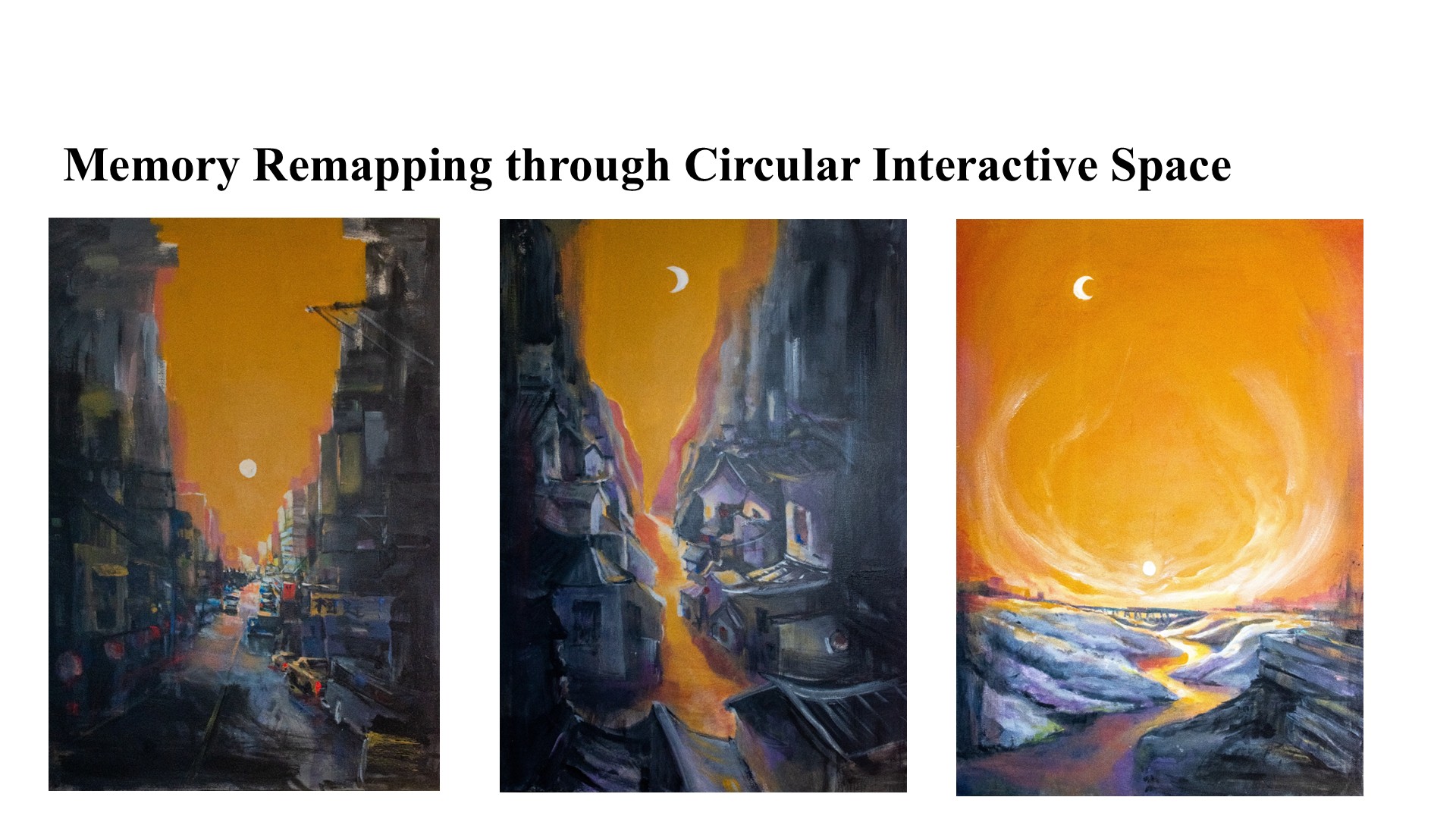
Three acrylic paintings of remembered Taiwanese spaces
Step 1

Acrylic Painting as Foundation Memory

The work begins from hand-painted images based on remembered Taiwanese spaces. These paintings hold the tactile and emotional origin of the project.

  • Urban Memory — A remembered city space shaped by movement, light, and distance.
  • Alley Memory — A compressed architectural memory, where buildings feel unstable and dream-like.
  • Landscape Memory — A symbolic environment where natural and urban memory merge.

Acrylic Painting BTS

Behind the scenes — acrylic painting process 1
Behind the scenes — acrylic painting process 2
Step 2

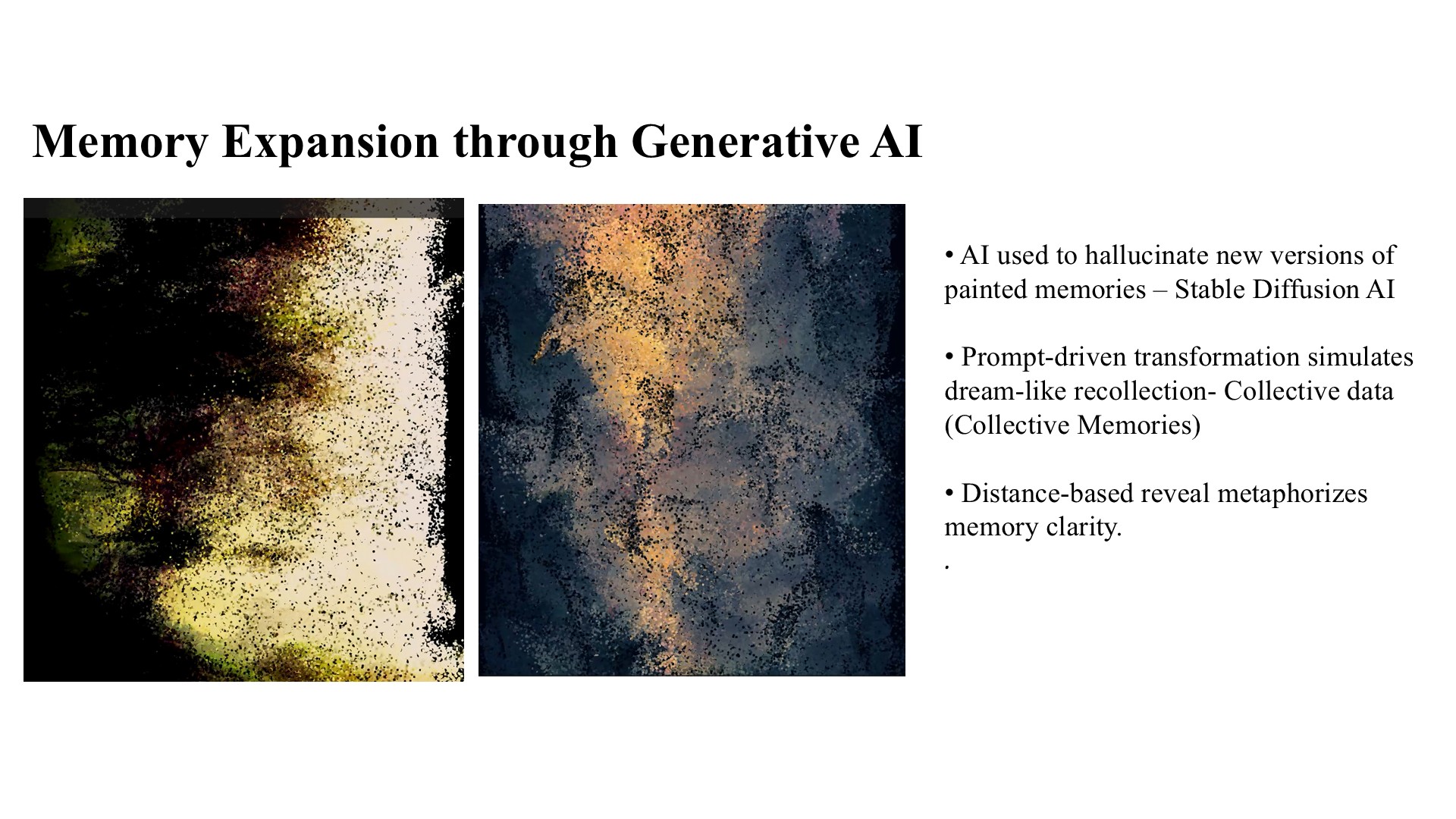
AI Image Generation as Memory Expansion

This video artwork reflects on the concept of memory hallucination by exploring how humans and machines differ in creating imagery. The sequences are generated from my original acrylic paintings, transformed into dream-like videos that maintain their structure while shifting their emotional tone — mirroring how memory is often fragmented and reconstructed.

The visuals transition from bustling streets to quiet countryside, as if dreaming. Layered particle effects reveal the full scene only from a distance — symbolizing how memories often become clearer with time and perspective.

Effect 1 — Memory Hallucination

Memory hallucination — shifting atmosphere

Effect 2 — Expanded Memory Sequences

Countryside — people walking and bird in the background
FamilyMart — people and cars passing by
Step 3

Real-Time Interactive System

The generated image layers, particle effects, gesture input, and projection output are woven together into one responsive environment — where memory shifts in real time as the viewer moves through the space.

Hand gesture controlling projected memory
Step 4

Gesture as Control

The viewer's hand position controls reveal, clear, particle size, and image blending. The body becomes the interface for negotiating between original memory and AI-transformed memory.

Projection mapping on painted canvases
Step 5

Projection Output

The circular projection space transforms memory from an image into an environment. Viewers are surrounded by fragmented visual layers, allowing memory to be experienced spatially.

Hand gesture controlling projected memory layers

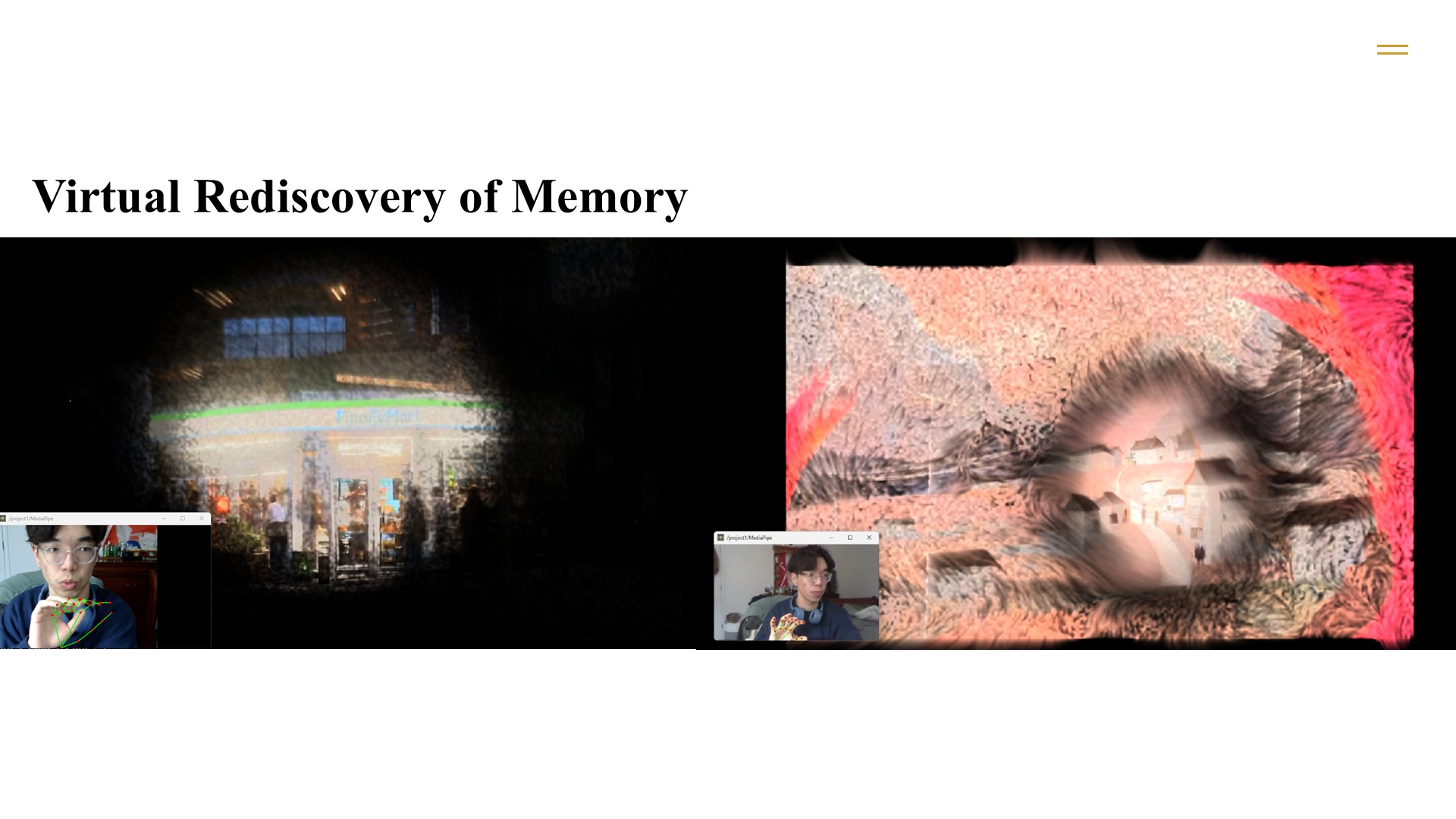
Rediscovering Memory Through Gesture

In the installation, the viewer does not passively look at an image. Their body becomes part of the memory system. Through hand gestures, they reveal hidden layers, clear visual noise, and activate particles that behave like drifting fragments of memory.

Gesture as a Way of Remembering

Reveal interaction mode with FamilyMart memory

Reveal

The viewer uncovers hidden AI-generated or painted image layers.

Clear interaction mode removing visual particles

Clear

Gesture movement removes or distorts visual particles, suggesting the instability of remembering.

Blend interaction mode merging memory layers

Blend

The original painting and AI-generated layer merge, showing memory as a negotiation between human intention and machine interpretation.

Interaction Documentation

Gesture Interaction

Hand gestures and projection in the installation — the body activates memory layers in real time.

Behind the Scenes — 1

Behind-the-scenes documentation of the interactive installation in development.

Audience Journey

  1. 1

    Encounter

    The viewer enters the space and sees a fragmented projected memory.

  2. 2

    Approach

    As the viewer moves closer, the image begins to reveal itself.

  3. 3

    Gesture

    Hand movement activates shifting visual layers and drifting memory fragments.

  4. 4

    Reflection

    The viewer experiences memory as something unstable, shared, and reconstructed.

AI as Creative Synergy

The goal is not to let AI decide what memory means, but to use AI as one layer in a larger human-centered system of remembering, translating, and re-experiencing.

In this project, AI is not treated as a final decision-maker. Instead, it is used as a generative collaborator within an artist-led system. The AI expands visual possibilities, but the artist defines the source material, selects the meaningful outputs, controls the interaction, and designs the audience experience.

Rather than being limited by the AI's generative choices, the artist must remain on top of the system: choosing what memories enter the model, how generated images are interpreted, how they are spatialized, and how viewers encounter them. AI becomes useful only when it is framed by human intention, cultural context, and visual communication.

Two AI-generated memory variations side by side
AI-generated variations based on the original painted memory. These images show how generative systems can produce new atmosphere, but still require artistic selection and contextual control.

The artist remains on top of the system. AI expands the image, but human intention gives it meaning.

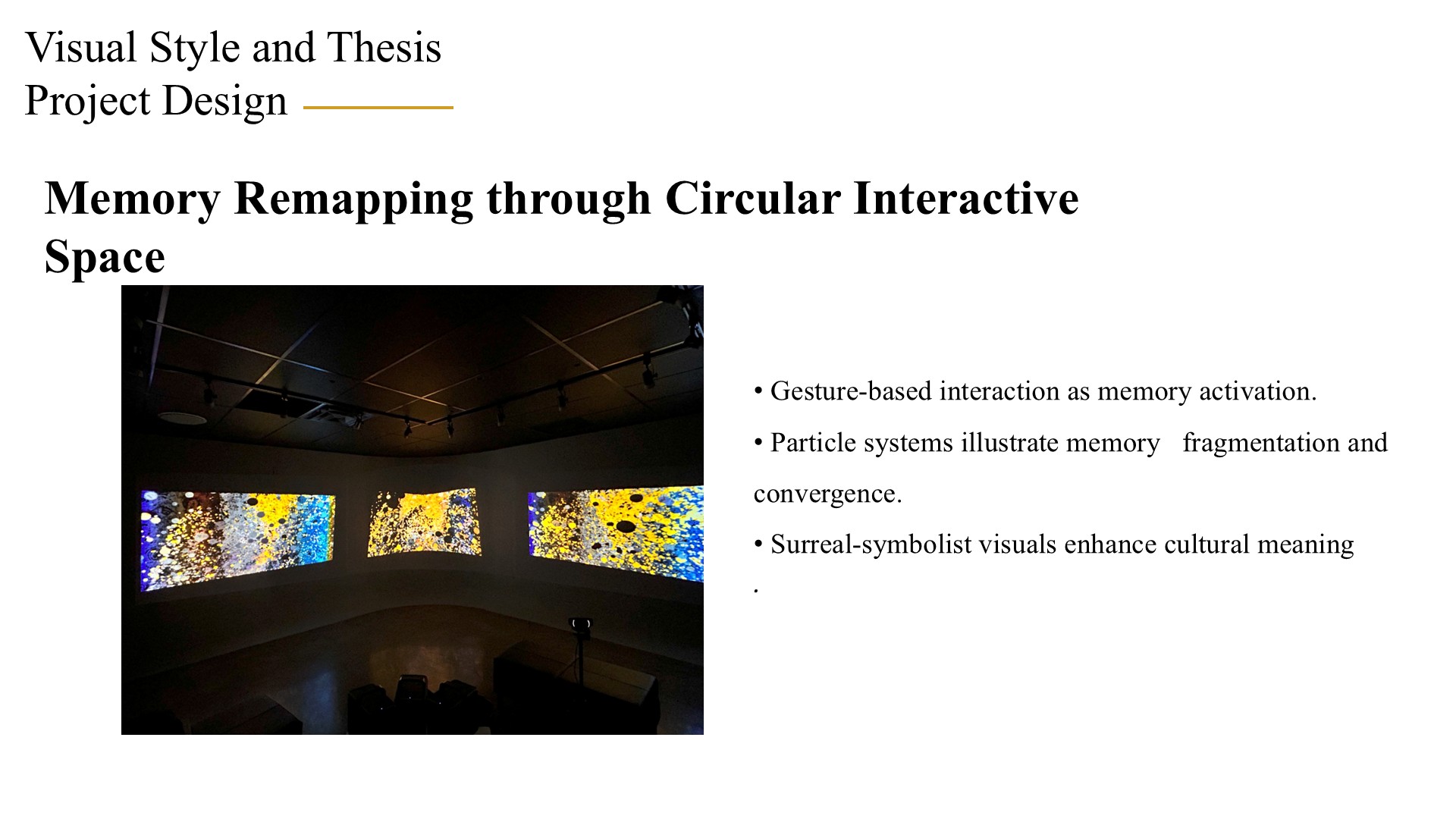
Memory Remapping Through Circular Space

The circular projection space transforms the viewer's relationship to the image. Instead of looking at memory from a distance, the audience is surrounded by it. The projected images, particle systems, and AI-generated textures create an environment where memory becomes spatial, fragmented, and immersive.

Projection detail with particles and texture

Projection Detail

Texture, particles, and AI-generated fragments mapped onto the space.

Audience perspective within projection mapping environment

Audience Perspective

The viewer encounters memory as an immersive and responsive environment.

Spatial composition of projected memory layers

Spatial Composition

The work combines multiple projected layers into one circular visual field.

Exhibition and Space

Documentation of the thesis exhibition — the physical space, installation views, and audience encounter with projected memory works in situ.

Exhibition documentation — space and installation view 1
Exhibition documentation — space and installation view 2

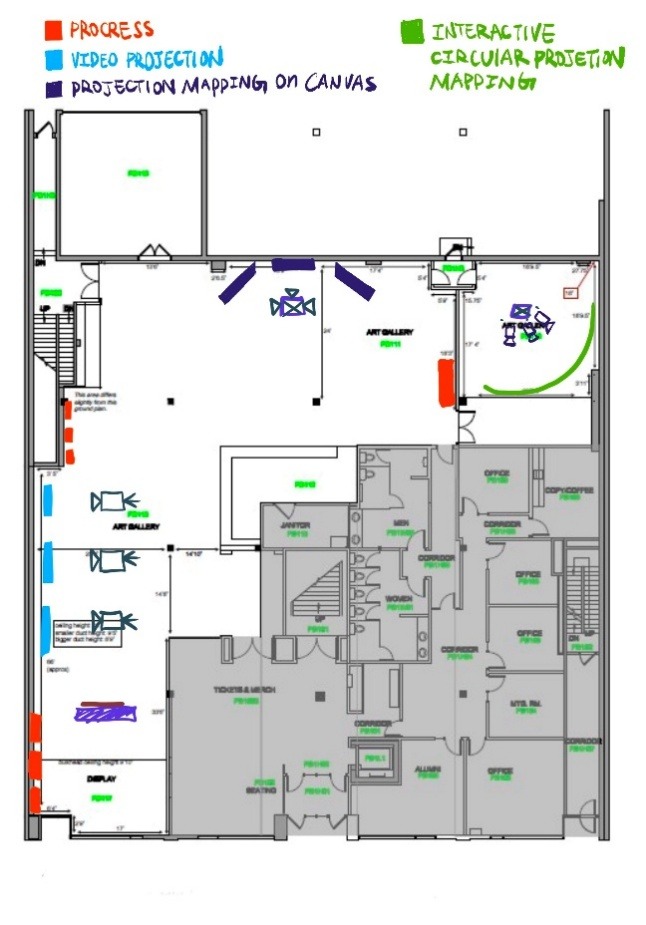
Exhibition Floor Plan

Spatial layout for the MFA thesis exhibition at the Penny Gallery, University of Lethbridge — mapping video projections, canvas mapping stations, progress plates, and the interactive circular projection room.

MFA thesis exhibition floor plan, Penny Gallery, University of Lethbridge
Figure 26 — Full exhibition floor plan with annotated installation stations across the Penny Gallery.
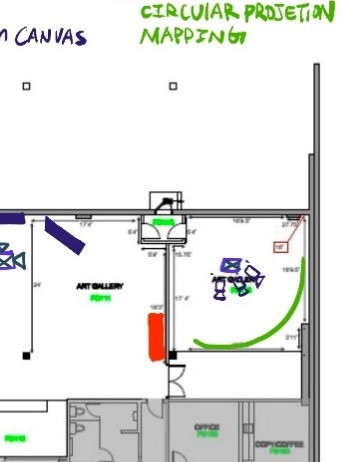
Circular projection room layout, Penny Gallery
Circular projection room — interactive 180° projection mapping setup in the gallery's curved space.
  • Progress plates
  • Video projection
  • Projection mapping on canvas
  • Interactive circular projection mapping

Click either plan to view full screen. For a guided tour of the installed exhibition, use on the hero.

Bridging Memory, Culture, and Technology

The Clash explores how traditional and digital media carry different emotional values. Painting provides a tactile and personal foundation, while digital interaction allows memory to become unstable, responsive, and spatial. AI expands the visual language of the work, but the meaning remains human-centered.

This project argues that artists and visual communicators should not be controlled by algorithmic decisions. Instead, we can design systems where AI supports human intention, cultural memory, and embodied experience. In this way, technology becomes not a replacement for memory, but a medium for rediscovering it.

Rather than allowing AI to control the direction of visual culture, artists and visual communicators can use AI as a controlled layer within a larger creative system. The goal is not to let the machine decide what memory means, but to design an experience where technology helps memory become visible, spatial, and emotionally convincing.
References

  1. Attie, Shimon. Mulackstrasse 32: Slide Projection of Former Kosher Butcher Shop (1930). 1992. Chromogenic print. Cleveland Museum of Art. Link
  2. Anadol, Refik. Machine Hallucinations: Latent Study—Mars. Link
  3. Anadol, Refik. Quantum Memories. Link
  4. Benjamin, Walter. "The Work of Art in the Age of Mechanical Reproduction." In Illuminations, edited by Hannah Arendt and translated by Harry Zohn. New York: Schocken Books, 1968.
  5. Barthes, Roland. "The Death of the Author." In Image, Music, Text, translated by Stephen Heath, 142–148. New York: Hill and Wang, 1977.
  6. Dalí, Salvador. Sewing Machine with Umbrellas in a Surrealist Landscape. 1941. Heide Museum of Modern Art.
  7. Manovich, Lev. The Language of New Media. Cambridge, MA: MIT Press, 2001.
  8. Nam June Paik Art Center. TV Buddha.
  9. Rinehart, Richard, and Jon Ippolito. Re-Collection: Art, New Media, and Social Memory. Cambridge, MA: MIT Press, 2014.